


“Meet/We’re The Superhumans”An Industry Guide To Advertising. - Exam
- Joel Nicholson

- Dec 19, 2019
- 13 min read

In 2012 and 2016, 4Creative wanted to change the world’s perspective on disability and there wasn’t a better chance to do that than to make an incredible advert campaign alongside a short-film called “Meet The Superhumans” for the 2012 Paralympic Games and “We’re The Superhumans” for the 2016 Paralympic Games that highlights disabled people working out, doing day-to-day activities as well as showing how the Paralympians may have became disabled.
Demographic Views and Theorist Views:
The First Short-Film was created to bring awareness and TV exposure to the 2012 Paralympic Games that took place in 2012 in London which certainly worked as 11 Million people tuned into the first ceremony of the 2012 games which was 3x more than the viewers that watched the Beijing Paralympics in 2008. Then for the 2016 campaign, "We’re the superhumans" became the second-most-shared Olympics-themed ad on social media of all time behind Procter & Gamble’s "Best Job" in 2012. Universal Music released “Yes I Can” performed by

the ad’s band of disabled musicians featuring Tony Dee, with proceeds going to the British Paralympic Association. Channel 4’s coverage of the Paralympics was watched by nearly half of the UK population. Viewing share across the 25-34 age group actually improved on London 2012 and the broadcaster’s audience share in September (when the competition was shown) increased 50% year on year. The 3-minute film challenges you to forget what you think you know about disability, and is a huge celebration of ability beyond disability. The social model of disability says that disability is caused by the way society is organised, rather than by a person's impairment or difference. 4Creative looked at ways of removing these barriers and so the Campaign was created. The short films uses many special techniques and codes and conventions in them. Firstly, linking to ‘Richard Dyer’s Theories of Stereotypes’, this conquers all stereotypes of disabled people, the short-Film shows these incredible humans doing activities the general public wouldn’t even be able to imagine they can do for example blind people being able to play Football, people with dwarfism being able to swim competitively, etc. Furthermore, the advert campaign demolishes Guy Cumberbatch’s theory that women aren’t shown much even though he found out that only 13% of central characters in the UK ads were women, while they make up 41% of the workforce and 51% of the population and that women are shown as housewives and men are shown as powerful people with job roles such as politicians, etc. However, this is not the case, you have Ellie Simmonds who is primarily shown as a ‘Superhuman with Superpowers’ who inspires a target audience of young girls, showing them that they can believe in their dreams. Alongside many more disabled females shown in the advert, providing the same success and the same unique dreams and I believe that the men are equally shown in both of the advert campaigns, showing them that they have the same equal rights as well as the females and that they are inspiring young audiences to believe in their dreams and working hard can achieve that. Both genders are equally shown and have the equal amount of power in the advert, showing why it has more success than anything at the time. Concluding this point further, this advert can be seen as a stepping-stone to the equal rights movement to the women because they are shown equally as the men and in 2012, the same old basis of women being shown as housewives, cleaning around the house still applied and even in 2016 as well, however this advert campaign shows them as powerful, supernatural beings. Lastly, the 2012 video also featured a Public Enemy record which is a huge deal because Public Enemy doesn't allow their music to be used on anything, therefore, when it is used, it’s used to make a social protest and that the statement is aimed to the general public that disabled people are ‘Superhuman’ and is a subcultural sense of pride.
Gunn’s Advertising Theory Types:

The Short Films use three different types of Gunn’s Advertising Theory types out of the twelve that he theorised. In ‘We're The Superhumans’ uses 140 different disabled people alongside celebrities such as Ellie Simmonds who is known for her amazing efforts in the Paralympics for Team GB. The short-film uses Associated User Imagery and the reason for this is to show the general public that just because disabled people have a disability, doesn't mean their vulnerable and it expresses to the community of disabled people that they can do anything they want to do and it doesn't matter that they have a disability because if anything their better than 'normal' people, they are 'Superhuman'. Then we can also say that the short-film uses Benefit causes story because the fact that the Paralympians are disabled is such a benefit because they are the superhumans for doing what they love and conquering societies opinion that disabled people are weak and that they can’t do any of the things imagined in the Paralympics event. This will have made the audience think again of what they know of disability and how it may restrict these people from doing activities that people who don’t have a disability can do however it’s opened all these doors for new opportunities that people who don’t have disabilities can’t do. This will have made the general public more supporting of the ‘Superhumans’ and want to support them and be proud of our country and for the Paralympics. The last theory of Gunn’s twelve types of advertising types in these short-films is actually Public Service Announcement which is a weird one because the short-film isn’t actually a Public Service Announcement from the Government, instead one that 4Creative has made to help change the stigma people may have for the Paralympics and help raise awareness to change people’s opinions on the Paralympians but not only the Paralympians, everyone that has a disability because they are now seen as the ‘Superhumans’.
Technical Effects and Codes and Conventions:
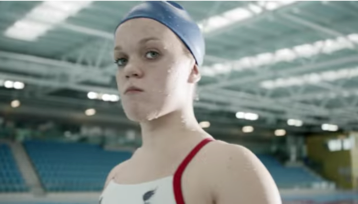

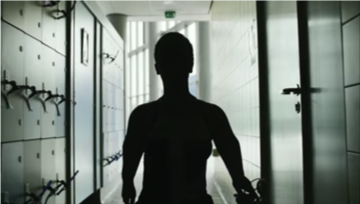


Furthermore, there is some technical effects used such as the camera angles enhance the perspective on what’s going on and shows the emotions running through the ‘Superhumans’ body, for instance, when we see Ellie Simmonds stood by the swimming pool, we can see the tension of how passionate she is about the sport. In one of the opening scenes, we see dark shadows of Ellie Simmonds coming out, which is a metaphor for people going out of the shadows, into the light meaning they’re going to spread positivity but also the shadows emphasise the seriousness that the athletes should be taken for. Furthermore, we also have the camera movement creating tension by showing everyone putting in their max efforts and then switching to an explosion in the war, a woman who is clearly pregnant with a scan of the baby’s heart-beating and a car flipping over which highlights how these ‘Superhumans gained their powers’ and then switching back to tense moments in the Paralympics which expresses that this event is real and means everything to our country. Linking to the explosion, the advert also expresses other violent scenes such as the two wheelchair basketball players colliding together and the car flipping over which emphasises that these people are tough, in fact people who overcome disability are stronger than others; that they’ve been through so much and linking with this, the lighting used in a scene represents the grittiness of the sport and is a grabbing hook to the attention of the audience because who trains in weather conditions such as this, the ‘Superhumans’.
How The Advert Campaign Met The Requirements For The ASA:

At first, the advert campaigns challenged the ASA because of the emotional trauma, scars and the life that society isn’t used to seeing on TV being shown to the general public. The campaign was being heavily criticised by members of the public for allegedly portraying unrealistic expectations of people with disabilities. Even, British Disability Activist Penny Pepper wrote in ‘The Guardian’ that, “The hyping of disabled athletes into superhuman status by Channel 4 only deepens our wounds, inflicted by continual assaults on our daily lives. It truly seems that the only acceptable disabled person is a Paralympian – and then only for a few weeks...the superhuman shtick is a tiresome diversion away from what is important. Let us be ordinary, let us be every day and let us at least have rights. Rights to independent living.” This as you would expect got the ASA wondering whether the advert should be banned or not but it was allowed to be shown on TV because it wasn’t against any guideline rules and it was just to promote both the 2012 and 2016 Paralympic Games. Furthermore, Channel 4 specifically worked with partnered charities such as ‘Action on Hearing Loss’, ‘The Royal Institution of Blind People’ and ‘Scope’, to make sure that they didn’t portray disabled people in a skewed, unrealistic way. Furthermore, linking to how the campaign was received by Thinkbox, they approved the advert campaign. This is because the advert is highly accessible and in fact is the most accessible advert campaign Channel4 has ever produced with the fact it has subtitles, signed and audio described versions of it available, therefore bypasses all regulations of it being accessible to everybody with any condition. The reason for all of this is because Alice Tonge, creative director for 4Creative said, “If you look at the dictionary definition of disability, it’s very negative – it says a condition which limits a person’s senses, movements or activities – and we wanted to challenge that definition” therefore this will challenge the general public’s stigma/mindset on disability. Lastly, 4Creative didn’t want to shy away from the specific physical attributes that these athletes have. 4Creative embraced these attributes and showed the ways they adapted their bodies to the particular sports.
Pathos, Ethos, Logos:

The Logos of this advert campaign is sending a message to the general public to raise awareness that the Paralympics isn’t the afterwards games from the Olympics that many people associated it with but instead is better than the Olympics, you’re looking at people with superpowers doing supernatural things. Therefore, the advert campaign is convincing the audience that this event shouldn’t be taken as a mockery because the athletes have a ‘disability’ and that the social model for disability should be removed alongside all it’s stereotypes because these people can do anything. Continuing on, the Ethos of this advert campaign is how it’s been represented from celebrity endorsement and what the campaign does, is it features 140 different disabled people, some that are famous Paralympians such as Ellie Simmonds, etc but you also have musicians such as Tony Dee who is a disabled songwriter and singer, so it has a wide range of well-known faces but also members of the general public to show the realism that ‘EVERYBODY’ with a disability is ‘SUPERHUMAN’. Finally, you have the Pathos which represents the audience’s emotions and thoughts given when a message is presented to them. The message of this advert campaign is to get rid of stereotypes of disabled people and the social model of disability and how they’re limited to do an amount of things however this is incorrect, they can do anything they want to do and a disability won’t stop them from doing anything. This would make the audience feel sorry for how they have treated people with a disability in the past because they may have looked down on them, thinking they aren’t as capable as ‘normal’ people in a harsh reality state but not realised that they are superhuman with superpowers. All of these techniques appeal to the target audience because it conquers stereotypes of not only “disability” as a whole but also makes the general public realise that the Paralympics is a huge event and not just the after-games of the Olympics, if anything it is better and with the target audience feeling like this, the Paralympics will have more engagement and viewership.
Additional Formatted Advert Campaigns:

For “Meet/We’re the Superhumans” advert campaign, they also feature print-based adverts which are just posters that would’ve been used in the tube stations or on bus adverts to promote the event. The banner highlights a different contrast of tone, one that is showing Ellie Simmonds putting on her goggles, ready for the competition with it being a green contrast which expresses winning and her being highlighted with a golden flair emphasising she is the golden medalist. Then on the other side of the banner, we have a disabled musician playing on his piano with a dark background to which us the audience can assume that he is playing in front of a crowd. The poster has scribbled out the noun “DISABILITY” allowing it to show “ABILITY” which expresses that this poster isn’t just aimed for the Paralympics but is an advert campaign for disability itself and the fact they are classed in this social bracket shows that they have abilities in different forms.

Then we have the main A4 sized poster of a Paralympic athlete showing off his biceps which emphasises the human nature trait of having a bit of arrogance however from the waist down, we see the prosthetic legs which instantly highlights that it is an advert campaign for the Paralympics. In the advert, it also has a blue-orange colour theme which is the perfect contrast for grabbing an audience's attention because it is aesthetically pleasing to look at meaning it will gain more attraction to the advert. Furthermore, disability is a protected characteristic meaning they are more likely going to be discriminated by the general public that’s why the advert represents the cross of disability and replaces it with ability which conveys the idea that they shouldn’t be looked down upon by the public. Continuing on, the anchorage of the print-based adverts are so important because it tells the audience that the ‘Superhumans’ are returning on a specific date, making sure that the audience know exactly when they are back on our TV screens. These print-based adverts also can be linked to Stuart Hall’s theory of representation, re-presenting the meaning of disability, if you get rid of the ‘dis’, you have the ability and that can be the ability to do anything. Stuart Hall believed in classification, classifying a group of people depending on their social class or genetic features because people need to be in a group and he believes that this is not necessarily a bad thing because we are all the same but can be identified as different and this is what has happened to disabled people. We are learnt classification and how to segregate people into different groups at a young age and so the general public believe that everyone with a disability is the same but this is not true. They have different stories, different ways of acceptance and different ‘super powers’, therefore the poster represents the idea of ‘disability’, now making us as the audience believe that everyone with a ‘disability’ actually has an ability.

Continuing on, the next print-based advert highlights that the Paralympics is the main-event and that the Olympics are the “warm-up”, that it isn’t seen as important as the Paralympics. This is a key marketing effect because it highlights the important upon the Superhumans, that everything they do is better than what anybody in the Olympics can do. They are better than ordinary people, that the whole event of the Paralympics is bigger than the huge phenomenal sporting event that happens every four years and what continues with the Paralympics. This brings huge hype to the event because how can anything be bigger than the Olympics, well the ‘Superhumans’ can change that. I believe this advertising method will have caused many ‘ordinary’ people, especially in the Olympic scene, to be raged because they might feel like they’re being dethroned in the ‘social class’ and that they don’t feel important or as good as people with a disability.
We then have the web-based advertising, I am using ‘Creative Review’ website because they talk about how effective the advert campaign was to the target audience and how it spread awareness. Now there isn’t a single web-based advert specifically by 4Creative talking about the ‘Meet/We’re The Superhumans’ campaign however, there are websites created by review sites, which in itself creates attention to the campaign because it’s spreading awareness and there will be new consumers from all across the globe reading these websites. The site has a clear black-bold font that instantly catches an audience’s eyes and tells the consumer what

advert campaign they are going to be reviewing and who it is by, this creates awareness to the production team of ‘4Creative’ because it is such a unique name but the page also features the latest moving-image based advert from the 2016 campaign which features Ellie Simmonds and so people will want to watch the video because she looks ‘normal’ which is why they used her as the advert’s thumbnail because the website but also 4Creative know that if they used somebody who looked disabled people with the stigma of hatred for disabled people would have an instant disinterest however because it features Ellie Simmonds who suffers from Dwarfism, the target audience wouldn’t know that unless they knew who she was already and therefore watch the video. Linking to this, the website wrote a message saying, “But I think that the feedback that we’ve had from lots of disabled people about the impact that it has had on the attitudes and mindsets of non-disabled people has been really profound,” he continues. “I’ve always said about diversity, and the Paralympics, that the most important thing is to get progress…. You’ve got to try and we’re learning – as is the rest of the world. This is the most important thing. The seeds of the Rio campaign came out of how disabled people reacted to the first one in London, and the seeds of what we’ll do for Tokyo have now been born out the reaction that people had to the Rio campaign.” This shows that the advert campaign altogether is breaking down the general public’s mind-set on the topic of disability and that the world is changing for the better in equality for every race, culture, background, etc. The website also features a lot of images from the advert campaign, that are aesthetically pleasing to look at and are attention grabbing hooks because they highlight the disabilities of different Paralympians as well as people such as Tony Dee that sings the “Yes I Can” song that was used in the 2016 campaign. This would make a typical audience realise that the category for ‘disability’ is a wide range of people with different and unique abilities differentiating them from other people classified in this social category.
Audience’s Across Different Media Sectors:
The target audience for the website is completely different to all the other formats of advertising because the website is aimed at everybody across the globe because it talks about the key features of the advert campaign, how effective it was and how it brought in more consumers to watch the Paralympics but also how it ‘normalised’ and conquered this stereotype and stigma against disabled people, allowing the general public to accept them. On the other hand, you have the print-based advert which seeks a target audience of just the general public preferably from the UK because it’s advertising and highlighting that the

Paralympics is on channel 4 which is only shown in the UK but then you have the Moving-Image based advert which in my opinion is aimed at people who look down upon people with a disability, thinking that they are linking back to what I said earlier, weak and vulnerable which is quite clearly not the case at all. Now, I believe this has been done because going back to protected characteristics, disability is one of them and disabled people are highly discriminated in a general environment because people believe that they can’t defend themselves and they aren’t able to live a ‘normal’ life, however, they’ve been through more trauma than anybody could imagine but they have gotten back up and are doing activities that ‘normal’ people couldn’t do nor even imagine to do. This brings a respected tone to the advert and conquers all of Richard Dyer’s model of stereotypes and shows that they can do anything they want too.
Conclusion:
To conclude, the general public had this portrayal that people with disabilities are weak and vulnerable. However, I believe that 4Creative have helped change this perspective to the general public, bringing awareness and allowing the public to believe and clearly see that people with a disability are ‘Superhuman’, the things they have been through and are now achieving are unimaginable to a ‘normal’ human-being.


Comments